Runs on Espresso
Menu
  • Home
  • Blog
  • Runs on Espresso Media
  • Planning
  • Runners
  • About Runs on Espresso
Menu

Blog

MakseLife Undated Quarterly Inserts Review

Posted on January 4, 2023January 11, 2023 by Jenna

For the final quarter of 2022, I wanted to try out the MakseLife daily inserts. Having them in my agenda would be handy, and I desperately wanted the weekly overview page. I grabbed a quarter when MakseLife had a big sale to clear out some of the older stock.

I used the inserts for October, November, and December. 

Personally, I don’t think the price point is worth it. Unless you are using it for all your planning. Each quarter is $44 ($176 for an entire year). You can get the flagship for $76 or the set of four companion notebooks for $58. The previous year is currently on sale for $26, which is much more reasonable. 

Overall, the undated inserts are really nice. They are meant to be punched and there is plenty of room in the margin without touching any of the actual planning areas. The companion notebooks can also be punched but because they aren’t specifically made for this, it does punch some of the writing areas.

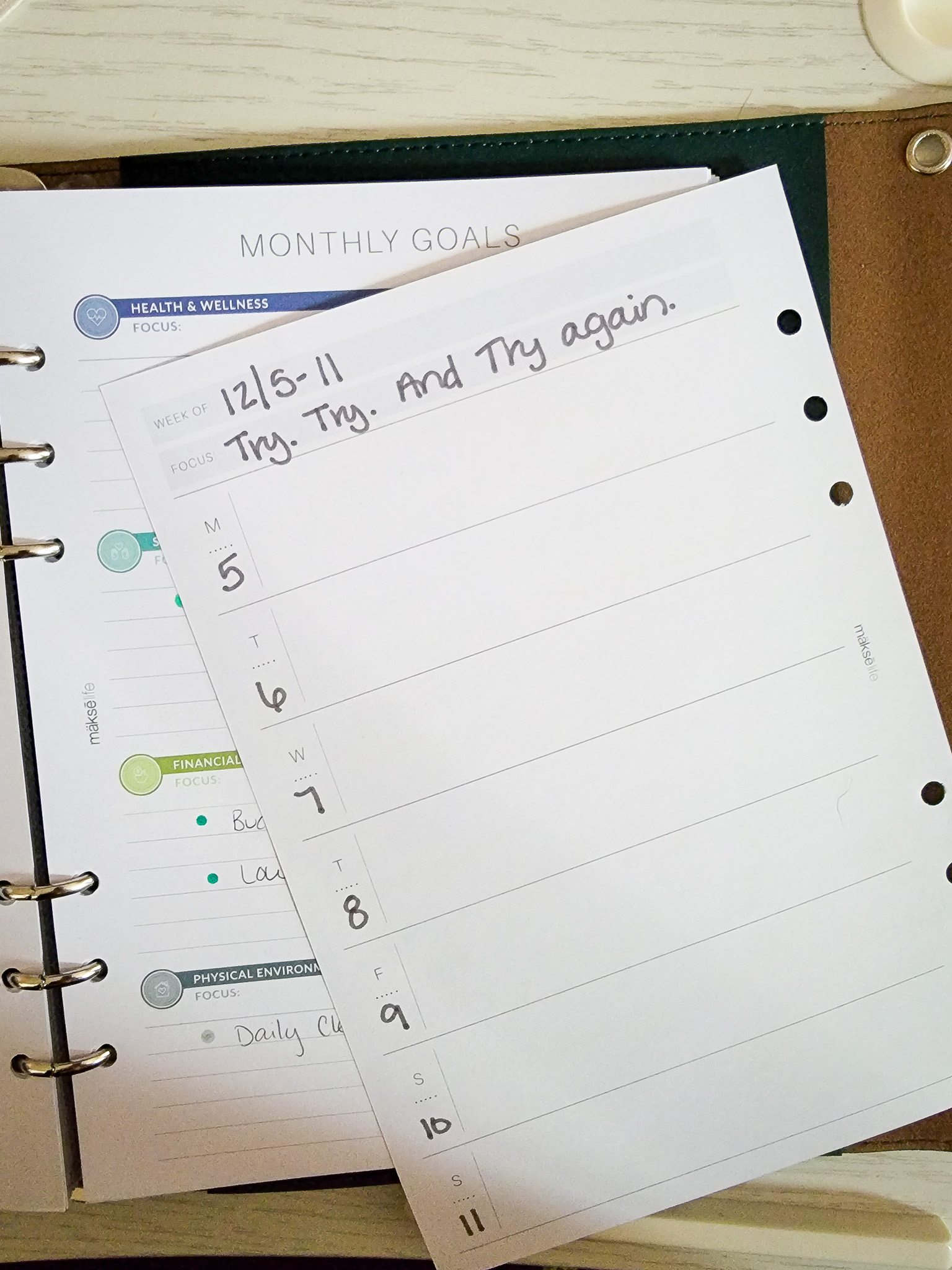
I wanted to try these inserts for the weekly overview. I loved the weekly action steps in the companion notebooks but didn’t like I had nowhere to plan them out over the week. The weekly overview page was set up nicely and I did like it but it was small. And I have large handwriting. Some weeks were harder to fit all my weekly actions on it. It definitely gave me ideas for how I want to use the flagship in 2023.

As I have an Erin Condren Daily Duo, I didn’t use the MakseLife daily inserts as intended. The daily pages are set up nicely with space for your daily focus, top three, to do list, a blank hourly area, and a dot grid space. I grab one when I have a couple of days I want to get a lot of content done. I can break out the different types of tasks in the to do list or hourly area and make notes in the dot grid section. 

The daily pages are great for many other uses!

The pages also work well for projects. I will put the project under the focus, put the top three things, and start making lists and time table for completion. 

Overall, the undated daily MakseLife is a great planner but for the price point, I just can’t recommend it. Even if I wanted to switch from my Daily Duo, I wouldn’t get this as it would be about $100 more per year than my daily duo. Lastly, I would never do an undated planner for my daily use. I’d be annoyed filling in all the dates!

Have you used the MakseLife quarterly undated daily inserts? What did you like about it? Do you think it’s worth $44 a quarter?

Interested in more planner reviews? Check out my YouTube and be sure to subscribe for future reviews!

2023 Fitness Planner Set Up and Goals

Posted on December 24, 2022July 12, 2023 by Jenna

Do you make health and/or fitness goals each year?

If so, how do you track your progress? Do you use an app, spreadsheet, or journal? Maybe you use a couple different ways to track? I believe keeping a fitness and/or health journal can help in so many ways. Often our progress isn’t noticeable from day to day but you can review your journal and really see how far you have really come. 

But before you can start planning and seeing how far you’ve come, you need to set some goals. 

My main goal is to get consistent with workouts, run five days a week, strength train 2-3 days, and yoga once a week. I also want to increase my fruit and vegetable intake and get my post-workout nutrition in check. My number one goal though is really to get back on track and find that consistency again.

What are your health and fitness goals for 2023?

There are many health and fitness journals you can get out there but sometimes having pre-made sections makes it hard to track what you want and need. I have found using a horizontal weekly planner works best for me. 

The monthly calendar allows me to plot out my workouts and track how many miles I ran each day. The dashboard gives me an area to track measurements, such as weigh-in, days worked out, and goals for the month. The weekly pages give me a space to write about each run and a spot to track my stats and the weather that day.

For 2023 I am using an Erin Condren A5 softbound in colorblends. I am hoping the colorblends inspire me to pick it up each day. I’ve been slacking on both working out and recording. But before I can start using it, I like to set up a few things.

I’ve tried many different fitness trackers and logs over the years and I find a horizontal weekly planner works best for me. For 2023 I am using the Erin Condren A5 souftbound because I LOVE the colorblends. The 12 boxes at the front are set for monthly tracking. I record my monthly weigh-in, measurements, blood pressure, and total miles. Each monthly dashboard has additional weigh-ins, measurements, and my goals for the month.

I prefer the horizontal layout because each day I can record how the run or workout went along with important stats like average pace and the weather. And there is a spot to total up weekly, monthly, and year-to-date mileage!

Now I am ready to attack 2023! What will you be using to track your health and fitness?

If you want to start running, sign up for my New Year, New Runner 5k program! It’s currently a free 10-week plan to run your first 5k! 

Review Your Goals and Get Ready for 2023

Posted on December 21, 2022December 15, 2022 by Jenna

Have you figured out your 2023 goals yet?

If not, you are not alone. I’m still trying to get mine all worked out. Maybe we can help each other get our goal planning on!

Before you set up 2023, let’s take a moment to review this year. And no judgment – you did awesome no matter how much you could get done. Some days you are a supper star and some days you need to chill on the couch. Both of those are ok! So no beating yourself up if you feel you fell short.

Use it to fuel your plans for next year instead.

You may want to grab some paper and your goals from way back in January 2022. My goals for 2022 were: 

  • Read 52 books
    • I did not hit 52 but read over 30
  • Use only current stickers
    • Nope, I bought tons new stickers BUT I did make a point to use many of my older stickers.
  • Watch 6-8 photo classes
    • Yes
  • Make art
    • Yes
  • Journal
    • Got off track for a few months
  • Lose weight
    • Nope
  • Run 50k
    • Nope
  • Yoga and strength work
    • Nope
  • Pay off credit card
    • Yes!
  • Build Emergency Fund to $2,000
    • Yes
  • Grow Social Media
    • Yes
  • Self Care Sundays
    • Fell off this one about six months in

Before you start setting goals for next year, think about a word of the year. I started really using this last year to help set my intentions for the year and it really helped. A word of the year should inspire you and give you guidance for your year. It can help you clarify and focus on who you want to be and what you want to accomplish. It’s all about how you want to grow.

This year my word was create. I wrote out both the dictionary and my definition and listed out ways I can create. I tried to do something each day that revolved around create.

For 2023, I picked the word renew. I put a lot of thought into my word and my why behind it. About a year ago I was diagnosed with ADHD and started medication in February. The diagnosis and medication made me realize how much I had been masking and how much of myself I was shoving down.

That is not a good feeling.

I decided I wanted to take the time to get to know me again. Renew is part of that journey. As my word of the year it will guide my year and help me to focus on digging my personality out. It will show up in some of my goals and activities.

What do you think your word of the year will be for 2023 and why? If you feel comfortable please share it with me. I would love to support you as you work towards whatever you want to accomplish!

Now that you’ve reviewed your previous goals and set your intention for the year, start thinking and planning out your goals for next year. You can pick your categories and start writing down your ideas. It’s ok to get messy here. Write something out, let it marinate for a few days, and come back to it. If it still resonates with you, keep it. If not? Scribble it out and write down what feels better.

You don’t have to figure out your goals all in one sitting.

I’ve been working on mine over the last few weeks and I think I’m finally getting them where I want them. They don’t need to be perfect and they don’t have to be forever. You may review them in a few months and adjust or drop them. 

The important part is getting something down to help guide your future actions.

I follow the MakseLife system and break my goals down by their categories. I have more in some areas than others and they may change over the year. Many of them revolve around things I love (art, photography, content creation) and finding out who I am (journaling, style). Not everything falls under finding out who I am but renew still applies. For example, our house is getting old and needs some small repairs and decluttering. The house is getting in on the renew too! 

What goals are you thinking about for next year? How do they tie back to your word of the year?

Want to have some planning and budgeting accountability? Join the Runs on Planning group for monthly challenges and support!

Track Yo Money

Posted on December 17, 2022December 13, 2022 by Jenna

Get ready to start putting your money to work for you when you track yo money!

We are going to put together a very basic monthly budget. You should have your past three months of paychecks and bank/credit statements handy. If not, you can pull them up online. 

First, add up all of your income sources. If your income is variable, figure out your average and round down. It’s best to underestimate your income. 

Second, go through your bank and credit card statements and determine your fixed and variable expenses. If you don’t know the difference, fixed is any bill you pay the same amount every month while variable can fluctuate. Now, determine your average monthly expenses. Here you will want to round up.

Third, take your average monthly income and subtract your average monthly expenses. Do you have a surplus or deficit? The goal is to get to eventually get to zero after expenses, debt payments, and savings. 

 If you have a surplus, you will need to determine where you want that money to go. Will you make extra credit card payments or save more? If you are negative, review and evaluate your expenses. Are there any obvious areas you can cut? I say cut, not eliminate, because budgets often fail when we jump too far in one direction. As you go over where your money has gone, do you see any subscriptions you don’t use anymore? Cancel those first. Cut one meal out per week or month. 

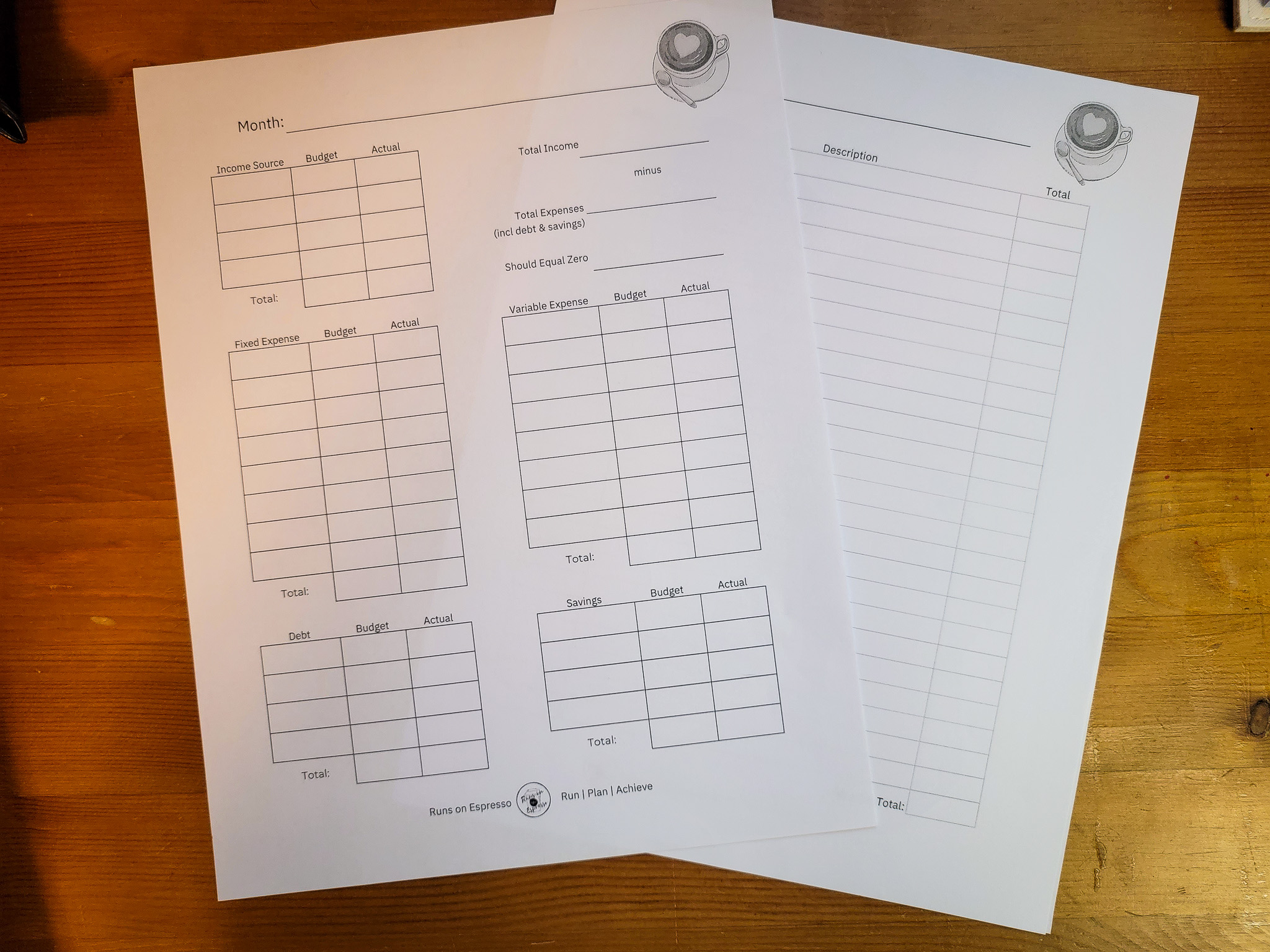
Now we will write out a very basic monthly budget to start using. Be sure to grab your monthly budget pdf here. You will put in the month and then fill out what you think you will spend for your fixed and variable expenses, any credit card payments, and anything you are able to save. When you end the month, you will fill in what you actually paid in each category and then see if you were over and under. 

When you start your budget for the next month, review the previous month. Where did you overspend? Do you need to budget more there for this month and reduce spending in another area? You will review and update your budget each month. Budgets are not a static thing. They are always changing. 

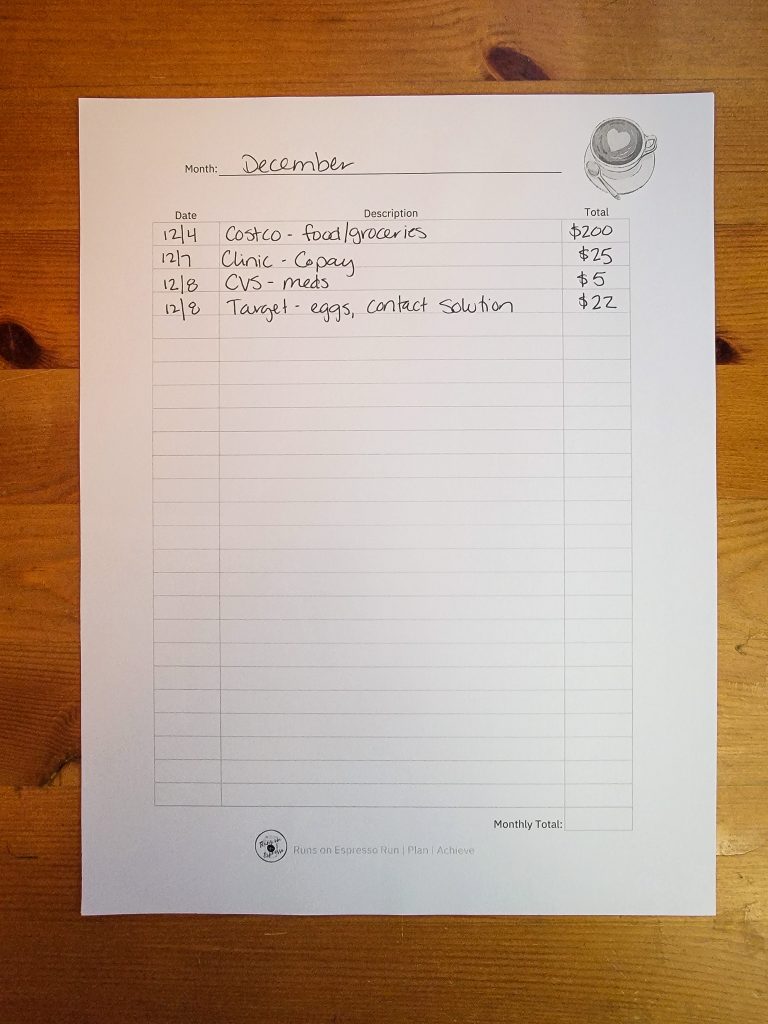
Your homework before the next blog is to start tracking your spending. Each day, set aside time to write down what you have spent that day or the previous day if you do this first thing. Write down what you bought, where, and how much. You can use a notebook, or spreadsheet, or grab my pdf here.

How does your basic budget look? Are you ready to tackle next month?

Grab your budget sheets .

Planner Basics

Posted on December 14, 2022December 13, 2022 by Jenna

Are you looking for some planner basics?

You’ve decided, 2023 is the year. You are finally get yourself organized and start using a planner! 

Maybe you’ve just been wanting to start planning because you have a lot going on at home or you started a new job and want to start off on the right foot. You have looked at a million blogs and planner sites, you’ve watched hundreds of hours of YouTube reviews and you have analysis paralysis. 

You do not know what you want anymore!

Don’t worry, you will get through this. We have all been there are some point, maybe even multiple points. You are not alone and you’ll find a planner. The first planner you pick might not be perfect but it will teach you what you like or don’t like and will help you choose better next time.

You are probably looking at many types of planners, from pre-printed to bullet journals. The first thing to think about is how much work do you want to do to be set up in your planner. Do you need something already dated or are you ok with an undated planner? Bullet Journals will be the most work as you decide what you want/need and put it in there. Take some time and think about this part. 

Pros & Cons Dated Planners

Pros: 

  • Everything is already printed and ready to dive right in!
  • Easy to find and sometimes you can get an older planner on sale to test it.
  • You don’t have to really think about the planner, you can jump right into planning.

Cons: 

  • Some things may not be applicable to you.
  • They are usually limited to January or July start dates and may not have it before January.
  • If you don’t use it for a while it feels like you wasted weeks or months.

Pros & Cons Undated Planners

Pros: 

  • You can start it anytime!
  • You can choose a Sunday or Monday start if they do not label the days of the weeks
  • You can put it down for a while and start back up anytime.

Cons: 

  • It takes a little effort to prep everything.
  • You have to write in (or sticker) all the months, dates, and sometimes days and may mess up (been there done that).
  • Some pages or dashboards may not be applicable to you.

Pros & Cons Bullet Journal

Pros:

  • You can make it anything you need or want.
  • You can change it each day, week, or month as you figure out what you really need.
  • You can make it simple when you need it and when you have more time you can get fancy!

Cons:

  • You have to spend time figuring out what you need or want.
  • You have to set everything up each month (at minimum).
  • It can be intimidating.

If you are starting out in planning or getting back in after some time away, a pre-printed planner might be a better choice than a bullet journal. If you want to move to a bullet journal later, you can use your planner experience to help determine your spreads.

If you have decided to go with a pre-printed planner, now you have to decide if you need a monthly, weekly, or daily. Monthly usually has the months with some note pages, some between months, and some at the end. Many people use monthly planners for budgeting or project planning. Weekly planners typically have the month followed by weekly spreads while daily is the month followed by daily pages. 

A few planners will offer monthly, weekly, and daily spreads but they are fairly rare, a bit more expensive, and quite chonky.

You can use more than one planner but to start I tend to recommend using only one and would say get a  weekly planner. You get a monthly view for your big picture planning or bill paying etc and then you can use the weeks to track your appointments, meal planning, tasks, and other weekly/daily items. 

Weekly planners usually offer hourly, vertical or horizontal layouts. Horizontal is the one most of us probably think about when we say planner. They have been around for pretty much ever and often are the layouts in school planners. If that style works for you? Great! If you have struggled with horizontal layouts in the past, consider a vertical one. 

You now have some planner basics to start your search. What planner do you think will work for you?

Stay tuned for next month because we will dig deep into selecting a planner in an ongoing series! 

Need a visual version of this post? Check out the YouTube version and don’t forget to subscribe for the ongoing series!

Does the Living Well Planner Work for Someone with ADHD?

Posted on December 13, 2022December 13, 2022 by Jenna

Does the Living Well planner work for someone with ADHD?

When first checking out the Living Well planner I was very excited. It seemed like it had everything, monthly and weekly spreads, space for goals and meal planning, plus budgeting! How awesome! You can have everything in ONE planner already laid out for you! You no longer need multiple planners. This is great!

But was it great?

The Living Well planner had potential and I think the calendar part would work well but the goal section needs more to it while the budgeting became overwhelming while still needing to catch up. Confused? Yeah, that’s how I was trying to figure out goals and budget here.

First, be sure you read the information at the beginning. I know, I know. Usually, you skip that stuff huh? It does offer some insight into the goal-setting pages. It also tells you to go to the website for more help… really?!?

The planner contains no real help in setting goals. You get a page to write out your long-term goals and two pages a month for goals. Each month you will pick your big three and a top goal. The top goal is your main focus. You will use the goal crushing page to break down your top goal. And that’s it. I guess even though you have a top three you are only supposed to do the one? It really doesn’t make sense.

The goal section is followed by a project planning page. I didn’t use this but I could see it being helpful if you have an event coming up or are doing some work around the house. 

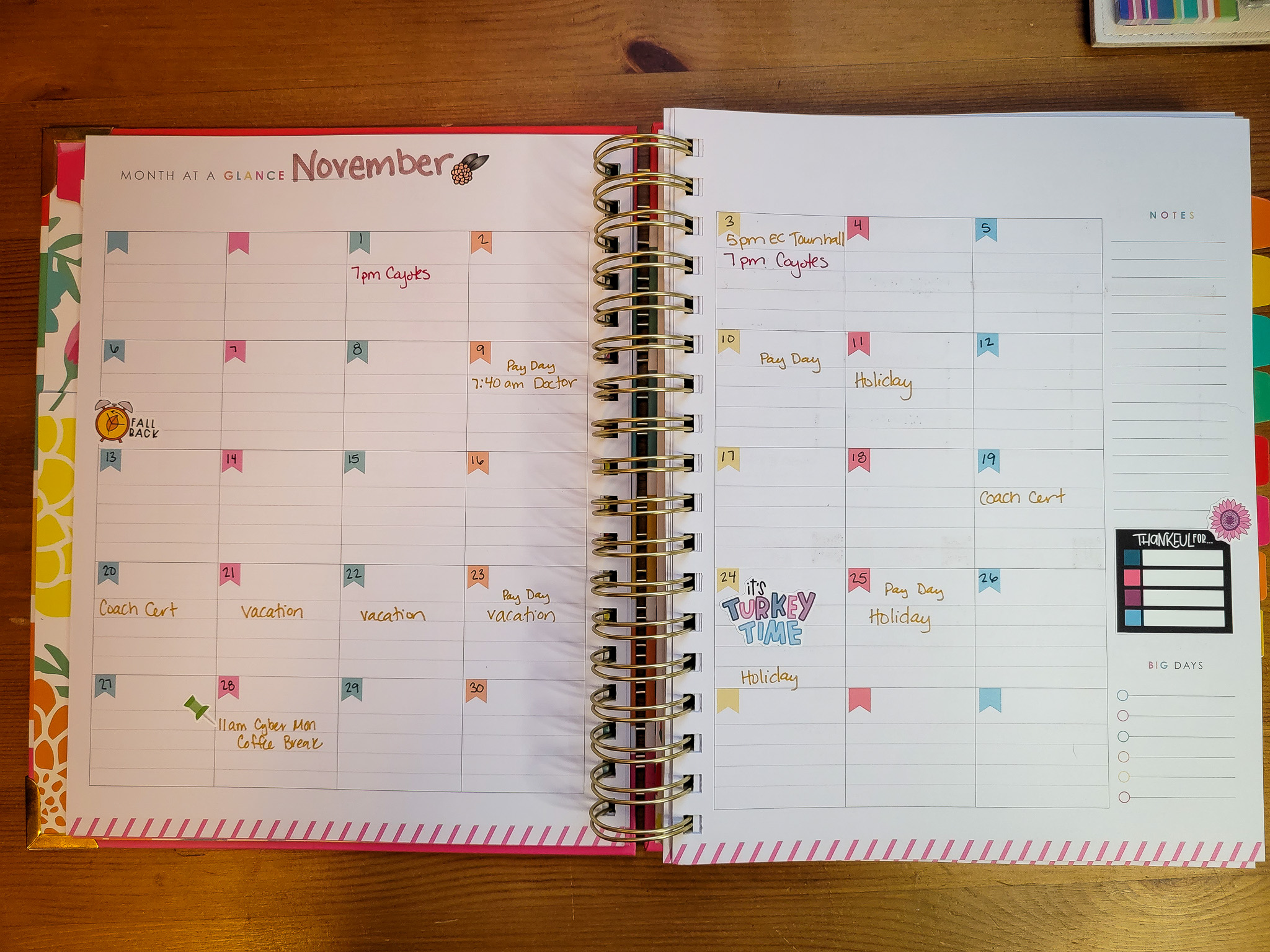
Then you move into the planning pages. You start with the monthly spread. I liked how this was set up. There is plenty of room on each day and they are lined. That might be the best part. It was easy to write in events. There is also a wide notes column and a spot for six big days. I didn’t use this but I could see it being handy to write down birthdays or events!

Then you get your weekly spreads. The layout is great but the hourly section does not allow for anything then on the hour appointments. The hourly section does go from 6 am to 10 pm which is more than most but you sacrifice half-hour spaces. 

Below the hourly section, you get your three must-do, and under that is a box for meal planning. You also have a notes column and big days on the side. There is room for six big days which seems a little silly as there are only seven days in the week. This made more sense in the monthly spread to highlight dates.

The weekly layout is fairly flexible.

You can use stickers and washi to section off the hourly or meal plan boxes if you need to add other categories or tasks. You can also use stickers to make items stick out. And the paper will hold up to highlighters with only slight ghosting. 

I could see myself using the planner parts of the Living Well planner.

Now you move to the budget pages. I tried to fill these in. I started. But I couldn’t do it. First, there are too many categories. Second, they have decided what ALL the categories are and where you will want them. I’ve found I need to keep my categories fairly simple or I get overwhelmed and give up on my budget. I would have rather they had left the expense columns blank and allowed you to fill in what you use.

On the budget spread, they have the income minus expenses equation but they give you zero space to enter your income. We get at least three or four checks a month, depending on where paydays fall. If you get paid once a month I guess this would work? Or maybe if you don’t have any variable income and get the same amount every month then maybe this would be ok.

On the next page, you get a spot for monthly expenses and money goals. You get 32 lines for expenses but they do not have a spot for categories. If you don’t make a note and then try to fill out the budget page you won’t know what category the expense goes to. It’s bizarre. 

I used the money plans and goals to list out our income. Or at least I started to. I never finished any of the budget pages. They didn’t make much sense to me. The budget pages were overwhelming but the monthly expenses page was underwhelming. It was missing a spot for categories. And there was nowhere to enter your income! 

Does anyone understand this budget section and can you explain it to me like I’m five?

Next up there is a thoughts and thank page. I didn’t use this but it is two columns with seven sections in each column (14 total) to record your gratitude. Since it is a fairly blank space you could use it for other things. It is next to the monthly expenses page so you could use it for budgeting. You could make it your cleaning schedule. 

Last, there is a line notes and idea page before you move into the next month. 

My final verdict? The planner pages would work pretty well for someone with ADHD. The only issue is the hourly section. I used stickers or wrote 7:30 if I had something that wasn’t on the hour. It’s not perfect but it can work.

The goals and budget section? Nope. I need more space on goals to do action steps for more than one goal. And the budget section was just a hot mess that made zero sense to an ADHD brain.

Interested in getting the Living Well Planner? Head over to YouTube and enter the giveaway by 12/23/2022.

Would you use the Living Well Planner? What do you think would work well and what fell short for you?

Erin Condren New Budget Review

Posted on December 4, 2022December 4, 2022 by Jenna

Is one of your goals for 2023 to finally start budgeting?

It’s one of those areas you say you will get to but never seem to follow through. You don’t know where to start or what you might need. You aren’t sure if a budget book would work for you, maybe it seems like a lot of work. 

Getting your budget in order can be difficult but it doesn’t have to be!

Erin Condren has come out with a new line of budgeting tools and sent me a box to check out, review, and give you my thoughts. You can grab your own items over on Erin Condren! Affiliate link. I will receive a commission if you purchase. I will always give you my honest opinion whether I am sent a product or purchase it myself.

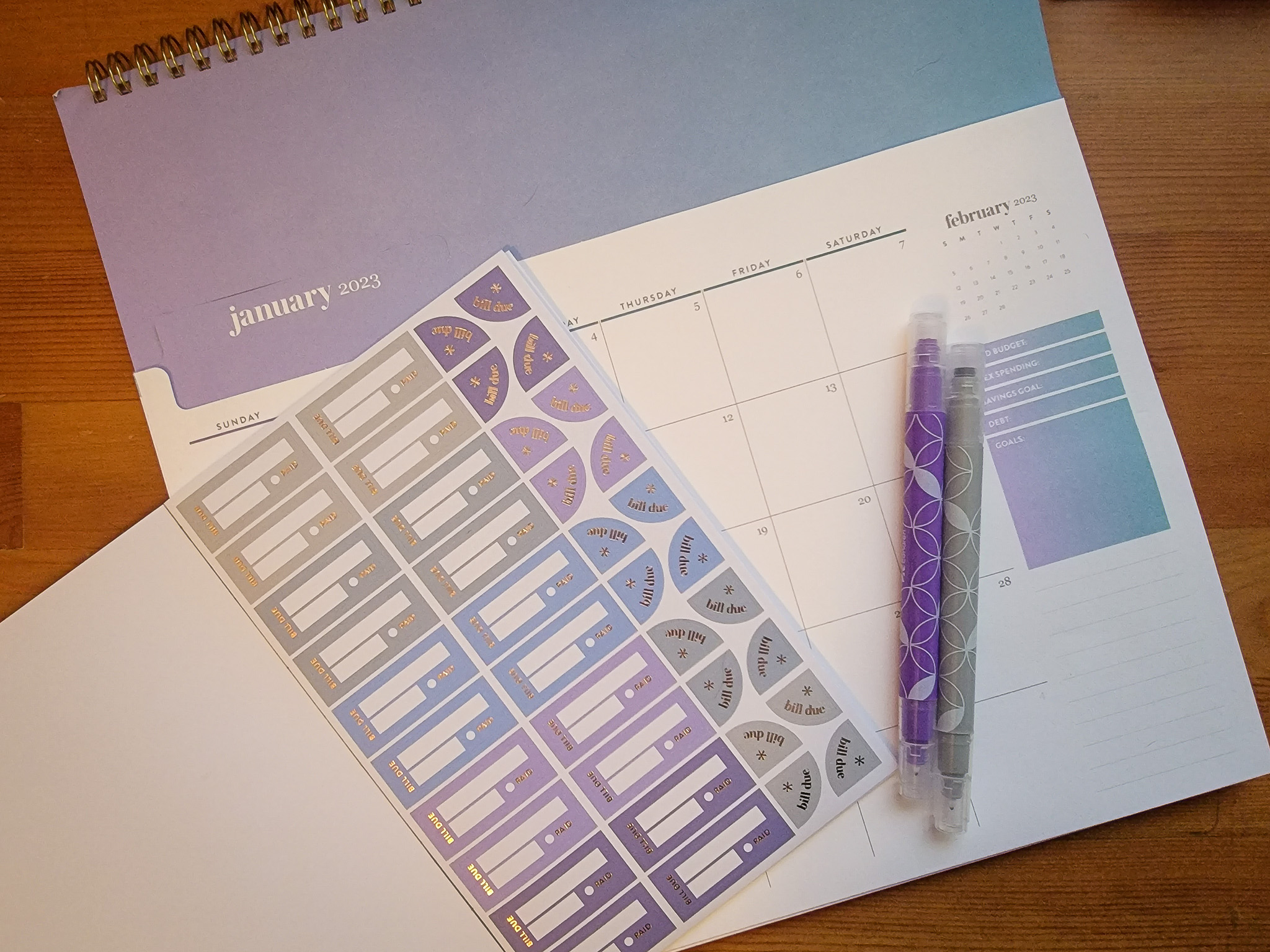
At first sight, the Budget File Folders Calendar isn’t very impressive. It’s a wall calendar, nothing special right? Wrong! Each month is also a file folder that you can tear off and file away. Perfect for storing all those receipts you need to turn over to your accountant at the end of the year. 

You could use the calendar to track your paydays and bills due plus there is plenty of room on the back side to track expenses or mileage if you drive for work/business. The back side also has a budget overview so you can see how much you spent each month. 

This is definitely one to get if you have a lot of receipts or other papers you want to keep track of each month. 

You also get a sheet of stickers at the very back of the calendar. I give it ☕☕☕☕ out of five, losing a coffee only because the folder tears off a tad too easily. My January is already coming off from flipping through for videos/photos. This may not be an issue if you aren’t manhandling it!

If wall calendars aren’t your thing you can also choose from the A5 Budget Planner in a coil or ring agenda. Currently, the ring agenda version is only available with the agenda. You cannot purchase only the inserts. Both versions are exactly the same inside so it really is which you prefer. 

You get 12 months of budgeting plus eight each of savings trackers, debt trackers, and special occasion budget pages. The planner is undated so you can start it anytime. The only drawback is you don’t get a monthly planner inside to track your paydays and bills. There is a bills/financial dates and deadlines list on the dashboard where you could put them but really a calendar view would be better if you need a visual version.

The dashboard also has boxes for “restock on” and “larger purchases”. If you don’t need these you could easily cover them with stickers and give them your own titles. The other side of the dashboard has a large box for your month’s financial goals. I don’t think it is large enough to draw in a calendar. There is also a to-do list and blank box. Overall the dashboard is fairly flexible and could be adjusted to fin your needs. 

The Monthly Overview is on the next two pages and it is great that you can see all your budget categories next to each other. The older A5 inserts are back to back and it can be a pain to flip back and forth. After the monthly overview, you get six weekly spending logs. You could easily use one for checking, one for credit card, one for your spouse, etc instead of weekly. 

If you were creative, you could use four (or however many paychecks you have) of the weekly spending logs to budget by paycheck with the other two as your expense trackers. 

At the beginning of the planner and after each quarter there are goal planning and check-ins, with the last one being a longer 12-month check-in. I would give the planner ☕☕☕☕1/2 out of five coffees because I’d still love to see a calendar view, even if it was blank and we had to fill it in. I also would love to see the inserts available without the agenda. Maybe next year.

I also received a handful of accessories.

First, the Flora Budget Accordion File would be another great place to stash receipts. You could also use this to hold your cash envelopes. Or to hold stickers. There are 12 sections in it. ☕☕☕☕☕out of five.

Second, the A5 Ring Agenda Budget Tracker Dashboard has room on the front for 13 bills to be tracked monthly while the backside is split between a savings and debt tracker. You could also track your budget category spending instead of bills. It is wet erase so at the end of the year, wipe off with water and start again! ☕☕☕☕☕out of five.

Maybe you don’t need a full budget planner but want to track your spending? Check out the Weekly Budget Tracker Notepad! There is room for your weekly budget and goal as well as debt paid down, added to savings, and next week’s budget. This would also work great for holiday budgeting or other special occasions! ☕☕☕☕☕out of five.

Next up is the Budget Dual-Tip List Markers. Each marker has a fine tip at one end and a stamp at the other. You get a circle, check, asterisk, and piggy bank all with black ink, an envelope (red ink), and a dollar sign (jade ink). ☕☕☕out of five. These are a great idea but the stamps take a little manipulation to get on the paper and the piggy bank, check, envelope, and dollar sign are hard to line up correctly.

The Budget Functional Sticker Book comes with a ton of stickers in a variety of options to track your budget. The book has both warm and cool tones stickers. They are absolutely beautiful! ☕☕☕☕☕☕☕☕☕☕ out of five.

Erin Condren has a lot of options to meet your budget needs. Want to see a video version of this review? Head over to YouTube. Be sure to subscribe as these products will be making an appearance in future videos and you can see how they will work with a real budget!

What items from the new budget collection are you most interested in? Which are you hoping to pick up?

Looking for budgeting and financial challenges or support system? Check out the Runs on Planning group because we will be getting our budgets in line in 2023!

November 2022 | Runs on Books

Posted on December 4, 2022July 12, 2023 by Jenna

A Merry Little Meet Cute by Julie Murphy and Sierra Simone

☕☕☕/5

When porn producer Teddy attempts to break into the cheesy Christmas movies biz, things don’t go quite as planned. When the main actress drops out, the director unknowingly picks a porn star to take her place, believing she is an indie film actress. Bee has always wanted to be a lead but there’s not much space in Hollywood for fat girls and she has built an empire on ClosedDoors. She is willing to help Teddy out, as long as everyone keeps her secret. 

She assumes no one working on a cheesy Christmas movie would also be watching porn.

Former boy band bad boy Noah hopes this Christmas movie will help turn his reputation around so he can help out his mom and younger sister. Will the porn star and reformed bad boy find love? Will Bee keep her secret and become the actress she dreamed of as a child? Will Noah keep up his new image?

I really struggled with my rating for this book. Usually, when I finish I know exactly how many coffees I will give but this one had me wavering. I really wanted to love this book but there’s something I can’t quite put my finger on that has held me back from a four or five coffee rating. 

The writing was good. I loved Julie Murphy’s Dumpling and I was expecting something more along those lines. I did not realize how… graphic this writing would be. I should have known better as it’s about a porn star but for some reason, I was thrown off by some of the language and sex scenes. But then I realized I should have known better based on the plot of the book.

My biggest issue with this book was I didn’t really connect with the characters. I didn’t care if Bee and Noah got together. I didn’t feel the urge to want to sit down and read for hours to finish the book. I didn’t find myself “yelling” at the characters to get together or wanting to smack the people getting in the way. This is why I ultimately settled on 3 out of 5. It wasn’t a horrible book but I also didn’t care. 

Deliberate Cruelty by Roseanne Montillo

☕️☕️☕️☕️/5

I listened to the audiobook version read by Mia Barron.

The childhoods of Truman Capote and Ann Woodward were quite similar. Both wanted to be part of the upper class, to be the socialites they only dreamed of as children with fraught, lower-class upbringings. Capote gained status as a literary icon while Woodward married into money.

One night, Woodward shoots her husband, mistaking him for an intruder. Many rumors circulated that it was not a mistake and Capote took those and ran. His In Cold Blood book was a best seller and he needed something salacious to follow it. He believes it will be the book that finally gets him to be truly accepted by those he surrounds himself with. But will it?

I have struggled with audiobooks in the past but am trying to embrace them more. I’ve found it really depends on the narrator and listening at 1.5 speed. I thought Mia Barron did a great job with Deliberate Cruelty. Her pacing was great and she varied her voice enough to not become monotonous. It was easy to tell when there was a paragraph break. 

The ADHD Advantage: What You Thought Was a Diagnosis May Be Your Greatest Strength by Dale Archer

☕/5 (I struggled through, skimmed a lot. It was that bad)

The ADHD Advantage attempts to break the stereotype that ADHD is a “bad” diagnosis and a scarlet letter for those diagnosed with it. The book presents examples of people that are successful because of their ADHD not despite it. 

Oh, boy, where to start with this one? I had high hopes as it was recommended to me by someone I trust and value their opinion. But I struggled with it. 

The forward was hard to get through but I pushed on thinking ok, well that’s this guy’s thought maybe the author will be a little different. Um, I was wrong. The entire book is very anti-medication. I understand not immediately jumping to medication for children but I can tell you it has made a HUGE difference in me. And it has not made me a zombie, in fact, it’s quite the opposite. Once I realized I had ADHD and started medication, I stopped trying to be like everyone else, to be “normal” and get back to the real me. The one I started hiding because I was constantly in trouble for talking too much or interrupting the adults. Or being the one that was “too much” for the friend group. I also get that is me. Medication may not be the right choice for everyone but that should be between you and your doctor, not a random author. 

Another big issue for me was Archer is a psychologist and self-diagnosed himself. Ummm, ok? That seems like a bad idea. And he claims he has never been medicated and has thrived despite his ADHD! Great. I was not medicated and made it 40ish years and did pretty well. But could I have done more if I was medicated? Or maybe even if I had gotten diagnosed sooner? Maybe, we will never know but I feel more myself and more able to accomplish things, especially adulting tasks that I always put off for more “fun” stuff, now that I know and am medicated. Ok, I keep going off on my experience. I will try to keep it to the book after this. 

Back to the forward, Allen Frances, MD who wrote the forward, also helped write the DSM IV for ADHD  and now claims ADHD is overdiagnosed and kids are just hyper so to put them in activities. Well, what about kids in activities that are still hyperactive? Ugh, this was just a tough forward to get through and I actually googled the man, and well, that made it harder to read. His current opinions and Twitter feed are just… gross for lack of a better term.

Archer’s writing made me feel that he thought he was better than other because he never took stimulants and was able to accomplish soooooo much 🙄. He said his score on his ADHD continum was 8 (I am a 9.7 so since I’m over 8 I am allowed to be medicated per his matrix).

I also did not like how he wrote about women with ADHD. The first time he mentioned it he said women have different “symptoms” and yes, symptoms were in quotes like we are faking it? Many times when a word is put in quotes it means the author doubts/doesn’t believe whatever is being discussed. 

Many of his examples are people that appear to have a lot of privilege which would make it easier to use your ADHD to your advantage. 

A lot of his what to do are things I’ve done my entire life, not realizing I had ADHD. I still do them but the medication helps me. And I’m less depressed. Less anxious. And not a comatose zombie like many of the people he interviewed claimed they felt on meds. So, take meds or don’t take meds but don’t tell me they are bad and not needed for ADHD. Like everything, it’s finding what works for you. 

Archer could probably just use the tips at the end of each chapter and do a blog instead of a book. It was far too long with extra not needed opinions in the chapters. Bullet points at the end were to the point without extra thoughts.

I cannot recommend this book. 

Does the Planner Pad Work for ADHD?

Posted on November 13, 2022November 10, 2022 by Jenna

I will admit when I first got the Planner Pad I thought it was going to be overwhelming and too much to actually work. 

Link is an Amazon Associate link, I may earn a commission if you purchase using my link,

I was presently surprised by this little gem!

The Planner Pad does come with instructions in front of the planner and a link to watch a video on their website. It feels intimidating but once you read through the instructions and/or watch the video it makes more sense. They also include ideas for how to use the calendars and notes in the back.

After the instructions are important phone numbers with room for names and numbers followed by a three-year calendar (mine has 2022, 2023, and 2024). After that is yearly planning for the same three years, then holidays, and a time zone map before we get into the actual planning pages.

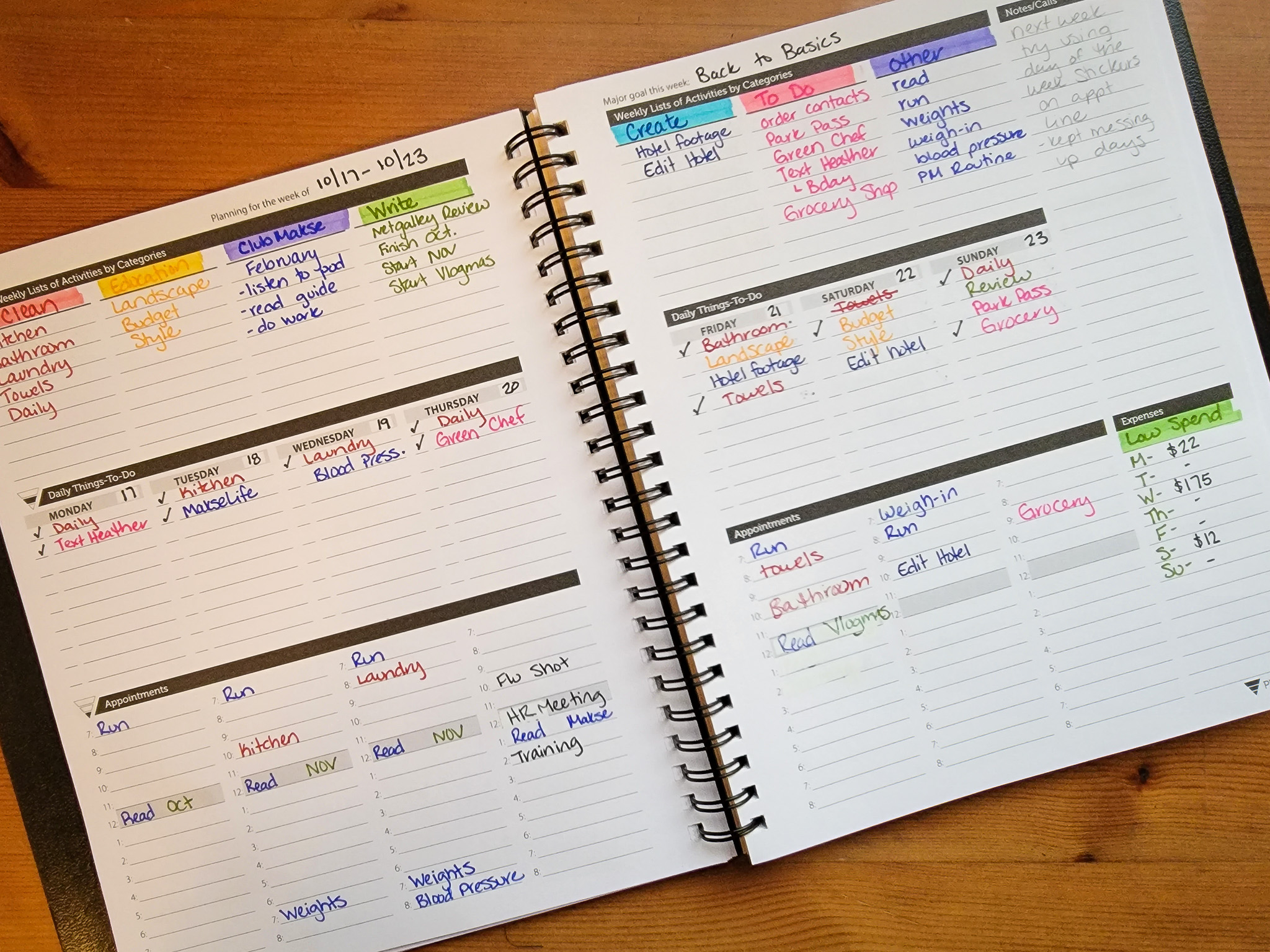
I used it for three weeks to get a good feel for it. The first week I used pencil because I wasn’t sure exactly how to use. You are given seven categories and I tried to think of seven areas of tasks that I had. I ended up changing them a bit for week two and liked those better and continued them into week three.

Once you pick your categories you fill in the activities or things you need to do in those categories. Then you go through and assign them to a day of the week and put them on the to-do list (middle) section. The bottom section is for appointments. The first week I tried to assign all my to-dos to a schedule and it did not work for me. It felt messy and redundant. For week two and three, I put in appointments, meetings, and a couple of the to-dos that I knew I would do at a certain time. 

The side bar in the personal size has a notes/calls section and an expenses section. I used the notes spot to jot down my thoughts on the planner and I attempted to use the expenses to track how much I spent each day. You could also repurpose it for tracking other habits with a little creativity and dot markers or highlighters. The instruction photo shows the dated executive size and the side column features mini months for the previous, current, and next month. I do not like mini months on ANY planner and am glad the undated personal size had none of that. Mini months take up valuable real estate! And if I wanted to see a month, I could flip my planner or use my Google calendar (which is what I do).

In the back of the Planner Pad are 12 goals/project pages and twelve note pages. You could use the goals/project pages as a monthly calendar. They also suggest using these for collecting info, taping in things you cut out of magazines, charts, quotes, or other items. They suggest using the notes pages for meetings, discussions and other such items. Personally, I probably wouldn’t use them. I rarely use note pages that in the back of planners. 

Initial Impressions

I think this could work really well with practice. Once you figure out your top categories, it becomes much easier. And I realize, as of writing this, you don’t actually need to fill all seven categories. If you only have three? You only use three of the columns. This may also change from week to week depending on what you have going on. Yah, not sure why it took me so long to figure this out. I guess I don’t want to waste space when testing something out?

I also felt the first week felt a little redundant doing the daily to-dos and then trying to put them on the appointments. If you are a timeblock type scheduler it may work for you but I tend to rebel against my schedule when I try to timeblock. I found it works best for me to just put most things on a daily to do list and not try to assign it to a time. But that’s me, you make LOVE this feature!

In week two I realized I kept putting appointments and items on the wrong day. The bottom section does not have the days of the week like the middle section does and I put all my Thursday meetings on Friday and needed to white it out and move them. I think the Planner Pad would benefit from carrying the days of the week to the bottom section as well.

I happened to have some days of the week stickers leftover and I used them in week three for the appointment section. It was much easier once I had the visual reference there. I looked at the dated ones on Amazon and they don’t have the days of the weeks in the appointment section either. I get most people will look at the middle/to-do section then follow down to the appointments but when I was adding meetings, I wasn’t pulling them from the to-do section as I don’t consider those to-dos!

The Bad

  • Steeper learning curve than a regular planner
  • No days of the week on appointments section
  • Appointment section runs from 7 am to 8 pm
  • No monthly calendar 
  • Only available on Amazon

The Good

  • Extremely Flexible
  • Spot to cross off in to-do section
  • Saturday and Sunday do not share space
  • Undated version means you can use as needed
  • No monthly calendar
  • You can be creative with color coding, dot markers, or highlighers
  • Slim enough to carry in purse, briefcase, or laptop bag
  • Price ($32 for undated personal size, $34 dated personal or executive size)

No monthly calendar gets put on both good and bad. For me? Fine, don’t need it. Don’t really use it. My monthly calendar gets filled in before the month starts and never referenced again. But I know others depend on it so that may be important to know. 

Final Verdict

The Planner Pad is a great tool and for some with ADHD would really help with what to do and when. It does take a little effort to figure out the best way to make it work for you but it just might be worth it! You can really personalize it to suit your needs.

By my third week, I had settled into my categories and set up my appointments to really work for me. I also loved using highlighter to add some color and be a little creative. The days of the week stickers would be something I would continue to use or a white gel pen to put the days on the black bar that seperates the columns. I need the visual reference for the section.

I debated about keeping this because I liked it so much but I cannot part with my daily planner. I thought about using it for work next year but I’d prefer the dated version for work. I actually need it every week and don’t want to waste time dating it. 

Since I am not keeping it, I will be removing the pages I used and giving it away! Head over to YouTube for your chance to win!

Tell me: Would you use the Planner Pad? What is your favorite and/or least favorite feature?

Find Your Why and How to Set Financial Goals

Posted on October 21, 2022October 12, 2022 by Jenna

Are you ready to start budgeting?

You’ve read through What is a Budget, and maybe you’ve even set up a Holiday Budget, but now you are ready to settle in and set your budget! What will the first steps be? We are going to figure out our why and set some goals. And I’ll give you homework for November’s blog. 

First, grab your budgeting worksheets so you can fill them out as we go.

We want to determine our why. Why do you want to budget? Why do you want to get your financial life in order? You can have one why or many. It really depends on what you are doing this for. If you are making a budget because it’s what you’re supposed to do, you will most likely fail. If you sit down and think about your why and realize you want to start a budget to stop living paycheck to paycheck or to help teach your children about money so they don’t struggle as you did, it will be easier to stick with your budget. 

Me, I want to get my finances in order so I don’t have to stress about money. I want to make sure I have enough to fund the experiences I want to do now and well into my retirement. I want to enjoy my retirement and not have to work full-time until I die. 

We will all have different whys and they will change over time.

Next, we are going to set our goals but first, we are going to answer some questions. You should be honest with yourself. No one else is going to see your answers. Your worksheet has space to answer these five questions.

  1. Think about your current financial situation. What is one thing you could do to improve your financials? How would your life change if you fixed just that one thing?
  2. What are your financial hopes and dreams? Think about the little things and the big, pie-in-the-sky stuff. Don’t limit yourself. Where do you want to be?
  3. Start a list of how you can improve your current finances. What could you cut out? What could you work to spend less on? Remember, this shouldn’t be all or nothing. You don’t want to cut everything all at once and end up feeling deprived and going on a spending spree. Can you make coffee at home? Maybe investing in a fancy coffee machine and some supplies would help save in the long run.
  4. What obstacles do you have? What are your money fears or limiting beliefs? Write down each obstacle and try to think of two or three solutions for each.
  5. Imagine how you will feel when you have reached your goals. Write it down. Reference it often, especially when you are struggling.

We have our why. We have taken some time to think about and answer the five questions. Now we will set some goals. We will decide on a few goals and pick one primary goal to work towards first. As stated above, we don’t want to go all in and get burnt out or feel like we will never reach our goals. Once you feel you have a good handle on goal number one, you can add in goal number two. You can also reach goal one and then move on to goal two. It will really depend on you and what your goals are. 

Of course, you will be reviewing and updating your goals as we go along. I tend to look at my goals every quarter and see if they are still relevant or serving me.

What kind of goals can you set?

  • Pay off credit card debt
  • Build an emergency fund
  • Stop living paycheck to paycheck
  • Plan for retirement
  • Improve credit
  • Payoff home or car loans
  • Start, or increase donations
  • Start investing
  • Write a will

Those are nine basic examples of the types of goals you can set and work towards. If you have credit card debt, you may want to start there. Write down your top three goals on your worksheet. 

First, pick the goal you want to prioritize. We will use credit card debt as our example. We are going to answer a few questions. Not all of these will be applicable to each goal so if you don’t have an answer for something it’s ok! Move on to the next one. And sometimes, you need to put in some work before you can answer! That is totally ok, make a note that you will come back after reviewing some resources. 

To start, answer the who, what, when, where, why, and how.

Who? You and your partner need to be on the same page. What? Pay down debt. When? We will start on our next credit card due date and it should take us six months to pay off. Where? Not applicable. Why? To have financial freedom. How? We will review the different methods and pick the one that works best for us. 

What do you need to accomplish this goal? What resources or supplies do you need? For your credit card debt, you may need all your current statements. You need to know what you owe and the interest rates. Are there any skills I need to brush up on? For the debt payoff, probably not. What do I need to learn? You need to learn HOW you will pay off the debt. Should I do the avalanche or snowball? Something different? You will read up on different methods and philosophies before deciding. You may want to try an online calculator to see which will pay it off fastest or with the least amount of interest. 

You’ve reviewed your resources and have decided to start with the snowball method. You think paying off the smallest debt first will give you a boost to keep going. You can update your how section now. 

Lastly, we are going to take each goal and break it into smaller, manageable steps. 

For our debt payoff, we will list our debts, minimum payments, and interest rates. Grab a notebook or spreadsheet and list your debts in the order you want to tackle them, based on the snowball method (smallest to largest).

We now have all our debt info in one spot. The next step will be to determine how much extra we can pay for our first debt. Maybe you can pay an extra $50 a month. Make a note on your list or spreadsheet. For me, my next step would be to write the bill and new payment amount on my bills calendar. Then when I go to pay bills, I’d consult my calendar, see my planned payment, and set up payment. You may go in and set up an autopay right away so you don’t forget. You may also set up the other card’s minimum payments at the same time.

Your steps may look different than mine. We will all have different small or manageable steps depending on how our brains work!

Let me know what financial goal you are going to prioritize in the comments.

I used the credit card payoff as an example because that is my main goal right now. I am also building an emergency fund but it is not my primary goal and is not where my focus lies right now.

Next month we will tackle starting our budget! Your homework is to gather your bank statements, credit card statements, and paychecks from the past three months! You will need them to figure out where the heck all your money is going!

Need a visual walkthrough of all the steps? Head over to YouTube and watch the video version (and don’t forget to subscribe so you don’t miss all the other budgeting videos that are coming)!

  • Previous
  • 1
  • …
  • 6
  • 7
  • 8
  • 9
  • 10
  • 11
  • 12
  • …
  • 45
  • Next
Jenna Volden is a paranormal horror author specializing in atmospheric ghost stories that blur the line between the supernatural and the psychological. Her work centers on mystery, reinvention, and unreliable narrators who may not be able to trust their own minds.

Jenna Volden

Author
Jenna Volden is a paranormal horror author specializing in atmospheric ghost stories that blur the line between the supernatural and the psychological. Her work centers on mystery, reinvention, and unreliable narrators who may not be able to trust their own minds.

  • January 9, 2025 by Jenna Embrace Bold in 2025: My Ambitious Goals for the Year
  • December 26, 2024 by Jenna How to Set Up Your New Planner for 2025
  • December 21, 2024 by Jenna Coming Soon!
  • December 9, 2024 by Jenna 2025 Planner Stack: Tools for Organizing My Messy Mind
  • December 2, 2024 by Jenna 2024 Planners in Review

Categories

Find Runs on Espresso

Visit Us On InstagramVisit Us On YoutubeVisit Us On FacebookVisit Us On TwitterVisit Us On Pinterest
Terms of Use
Privacy Policy

Copyright Runs on Espresso/J Volden Creative LLC 2023

© 2026 Runs on Espresso | Powered by Minimalist Blog WordPress Theme